
← Journal KODAMA
JOURNAL / FORENSICS
KODAMA JOURNAL INVESTIGATION 8 MIN READ

The evidence that changed everything

An investigation rarely fails because the truth was invisible. More often, it collapses because the room was filled with answers no one was trained to read—until a single discarded scrap of fact quietly dismantled the entire narrative.

SCROLL TO READ

Every crime scene is a conversation that ended too quickly. Long after the yellow tape is rolled away and the floorboards stop creaking, the physical record remains fixed. A dust outline on a windowsill. A timestamp recorded in a server log that doesn't match a witness's memory. A receipt folded twice and left in the pocket of an old coat.

When a major case stumbles, the popular assumption is that investigators lacked information. But those who spend years working within the machinery of criminal inquiry know a quieter, more troubling truth: the crucial piece of evidence is almost always sitting in plain sight, logged on page thirty-four of an evidence binder, waiting for someone to stop seeing what they expected to find.

The human mind is a story machine. Presented with three disjointed facts, it will invent a fourth to bind them into a neat, persuasive arc. In high-stakes investigations, this instinct becomes a quiet liability. Once a initial theory takes root—a suspect identified, a motive assumed, a timeline mapped—every subsequent piece of physical data is quietly filtered through that lens.

What happens when the key that unlocks a decade-old cold case isn't a miraculous scientific breakthrough, but simply a second look at a line item everyone dismissed as noise?

A dimly lit archival table spread with old case files, photographic prints, and magnifying glasses
THE ARCHIVE / 01

We rarely fail to see the evidence. We fail to recognize its weight.

HOW GOOD INTENTIONS BUILD BAD THEORIES

The danger of an explanation that sounds too complete.

In forensic psychology, the phenomenon known as confirmation bias—or, more acutely in criminal justice, "tunnel vision"—is not a sign of incompetence or malice. It is a fundamental cognitive shortcut that affects seasoned detectives and novice analysts alike.

When an initial hypothesis feels solid, contradictory signals are reinterpreted as anomalies. A missing watch becomes proof of robbery rather than a misplaced personal item. A witness's hesitation is logged as fear rather than genuine uncertainty. The narrative hardens like drying plaster.

Consider how evidence moves through the chain of custody. It isn't just physical material being passed from hand to hand; it is context. A forensic pathologist receiving a tissue sample accompanied by a note reading "suspected poisoning" reads the slide under a different mental light than one marked "routine screening."

This contextual priming can carry a case down a singular road for months—or decades—before someone steps back and asks whether the original premise was ever tested against the raw physical record.
“
A theory will happily devour every piece of evidence you feed it, right up until the moment reality refuses to digest it.
KODAMA / JOURNAL NOTE

The facts do not speak for themselves.
They answer only the questions we think to ask.

WHEN SMALL DETAILS COLLAPSE GRAND ARCHITECTURES

Revisiting the physical record with fresh coldness.

The turn usually arrives without drama. It doesn't happen with a dramatic courtroom confession or a sudden middle-of-the-night raid. It happens in a quiet office with bad coffee, when a technician re-runs a sample using a slightly different calibration, or an investigator notices an anomaly in a digital phone tower log that everyone assumed was a glitch.

Take the evolution of digital forensics over the past decade. Earlier investigations treated cell phone records as simple location stamps—a tower ping placement placing a suspect within a three-mile radius. As analytical models grew more refined, researchers realized that signal attenuation, atmospheric humidity, and local traffic patterns could bounce a signal miles away from its physical source.

Suddenly, the cornerstone piece of physical evidence that bound a defendant to a crime scene at 11:14 PM was revealed to be a phantom metric. The timeline shattered. The entire structure built around that hour collapsed overnight.

These moments of reversal force a humbling realization: physical evidence doesn't lie, but our interpretation of it is inherently perishable. What felt definitive five years ago can become an embarrassing oversight under the light of new methodology or disciplined scrutiny.

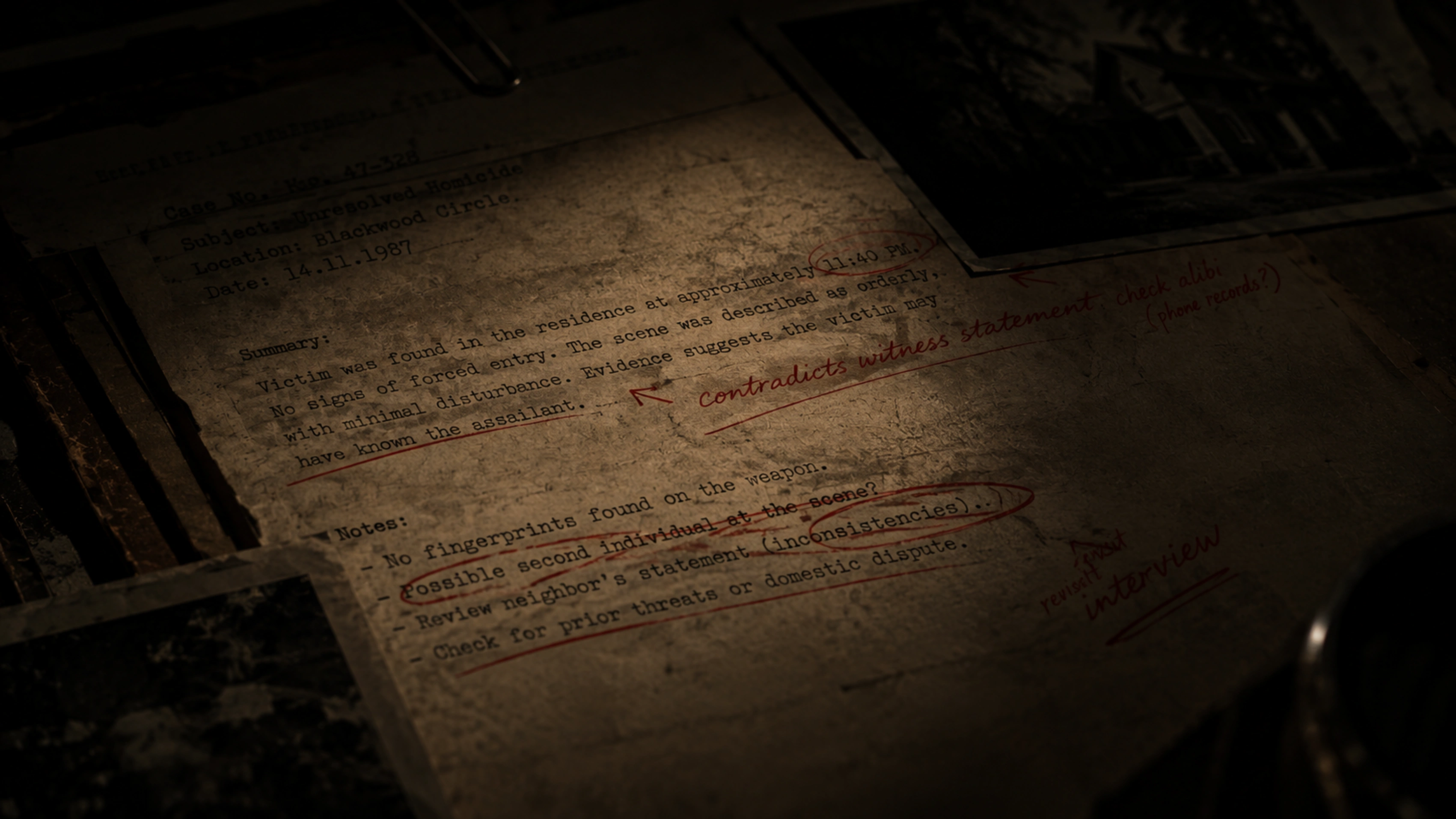
Close-up of a forensic document showing typed notes with handwritten red ink corrections

WHAT IT TAKES TO ADMIT A NARRATIVE WAS WRONG

The courage required to abandon a settled story.

Admitting that a foundational piece of evidence was misread requires more than intellectual honesty.

It demands dismantle years of work, facing victims' families, and accepting the uncomfortable weight of human error.

Institutional inertia is a powerful force. Once an arrest is made and press conferences are held, the system naturally seeks closure. Questioning a key detail long after the trial feels like opening a dam.

Yet the integrity of the investigative discipline depends entirely on those willing to tug on a loose thread, even when knowing it might unspool the entire carpet. True justice is rarely neat; it is an unglamorous, perpetual audit of past assumptions.

A DETAIL IS ONLY SMALL UNTIL IT IS UNDERSTOOD.

The difference between a solved mystery and an enduring tragedy often rests on a single unread line.

BUILDING A CULTURE OF SCIENTIFIC HUMILITY

How forensic science is learning to doubt itself.

Modern criminology is experiencing a quiet revolution driven by blind testing, contextual information management, and independent review boards. We are moving away from the era of the heroic detective who "knows" who is guilty by intuition, toward a far more rigorous, cold-eyed methodology.

By intentionally stripping non-forensic details from analysts—ensuring a fingerprint expert does not know if the sample belongs to a prime suspect or a passerby—the system builds artificial walls against cognitive bias.

The goal is not to eliminate human intuition, but to protect it from its own worst habits. When an overlooked detail finally comes to light today, it is less often a matter of luck, and more often the result of a system built to question its own memory.

THE FINAL METRIC

The truth doesn't change when we miss it. It simply waits for us to grow quiet enough to notice.

Whether in criminal justice, historical research, or our own daily lives, the stories we tell ourselves are fragile constructions. They hold together only as long as we refuse to look at the edge of the frame.

The most valuable habit an investigator can cultivate isn't relentless certainty—it is the willingness to be proven wrong by a piece of dust, a misread date, or a single detail that refuses to sit quietly where it was placed.

Look closer at what you think you already know. That is usually where the real story begins.
RESEARCH NOTES FORENSICS / SOURCES
01
PubMed Central / Interpol Review

Systematic Review of Forensic Science Management and Cognitive Bias: Examining cognitive impenetrability and tunnel vision in physical evidence interpretation.

02
Forensic Science International

An augmented evidence base for the interpretation of forensic text and digital communications evidence in crime reconstruction.

03
Melbourne University Law Review

Forensic Science Evidence and the Limits of Cross-Examination: Case studies on unexamined subjective bias in latent fingerprint and physical trace identification.

04
UK Government Office for Science

Forensic Science and Beyond: Authenticity, Provenance, and Assurance — Analysis of systemic errors in historical case evidence.

NEXT IN THE JOURNAL The psychology of the stranger ↗